
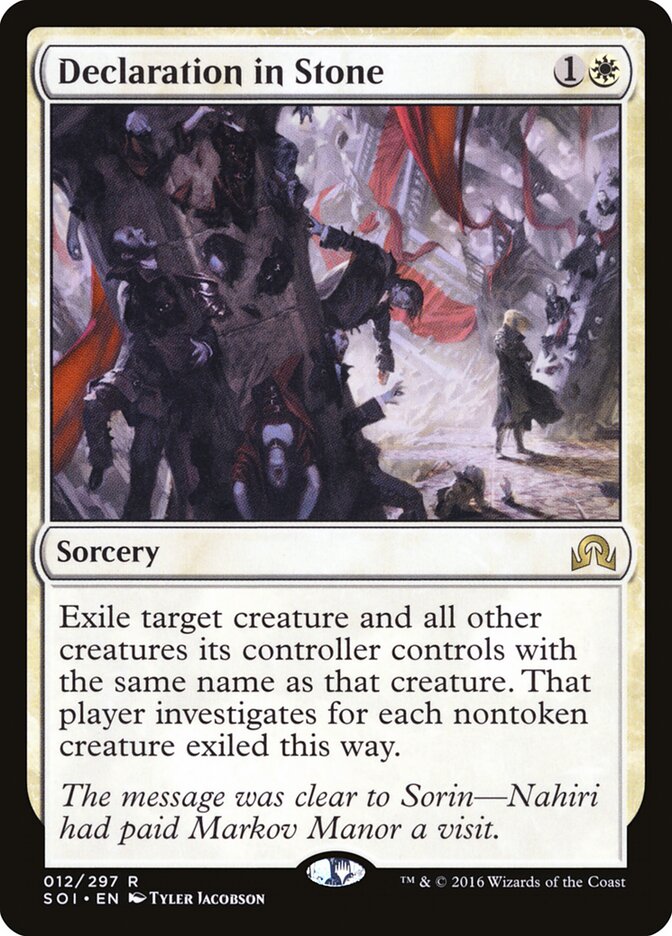
石の宣告


Declaration in Stone
ソーサリー
クリーチャー1体を対象とする。それと、それのコントローラーがコントロールするそれと同じ名前を持つ他のクリーチャーをすべて追放する。そのプレイヤーは、これにより追放されたトークンでないクリーチャー1体につき1回調査を行う。
これがどういうことなのかソリンには明白だった。ナヒリがマルコフ荘園に来たのだ。
イラスト:
 Shadows over Innistrad#12レア英語
適正
裁定
If an effect refers to a Clue, it means any Clue artifact, not just a Clue artifact token. For example, you can sacrifice Wrench to pay for Alquist Proft, Master Sleuth's activated ability.
Declaration in Stone has only one target. The other creatures with that name aren't targeted. For example, a creature with hexproof will be exiled if it has the same name as the target creature.
A face-down creature, such as one cast with a megamorph ability from the Dragons of Tarkir set, has no name and can't share a name with any other creatures.
It's possible to have a creature and a noncreature permanent with the same name, such as two copies of the same land, one of which has become a land creature. Only creatures with that name are exiled by Declaration in Stone.
Clue is an artifact type. Even though it appears on some cards with other permanent types, it's never a creature type, a land type, or anything but an artifact type.
You can't sacrifice a Clue to pay multiple costs. For example, you can't sacrifice a Clue token to activate its own ability and also to activate Alquist Proft, Master Sleuth's ability.
If the target creature is an illegal target when Declaration in Stone tries to resolve, it won't resolve and none of its effects will happen. No creatures will be exiled, including those with the same name as the target.
Unless a token is a copy of another permanent or was explicitly given a name by the effect that created it, its name is the subtypes it was given when it was created plus the word "Token." For example, if an effect creates a 1/1 Soldier creature token, that token is named "Soldier Token."