
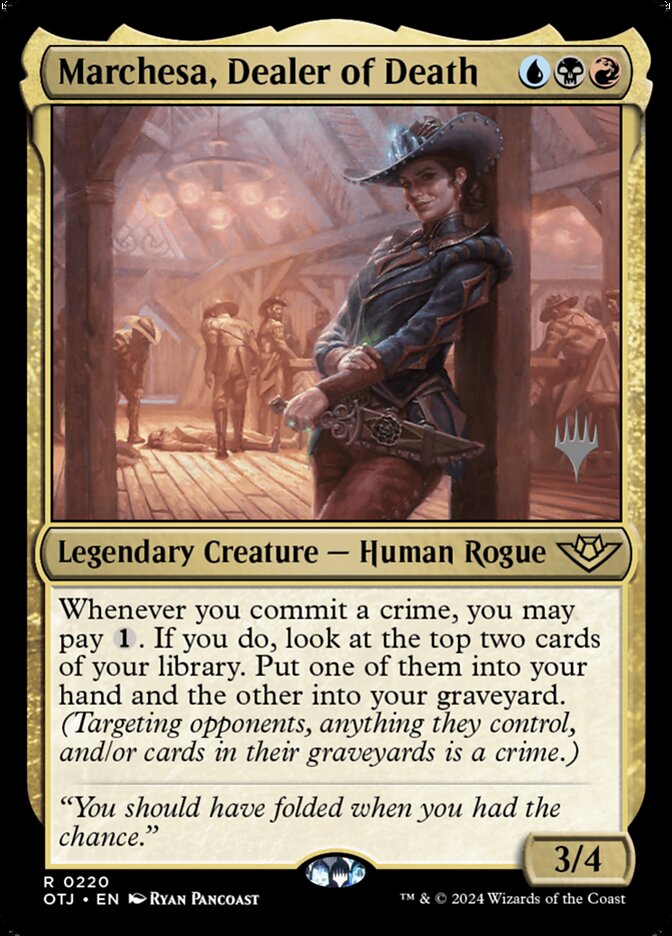
死のディーラー、マルチェッサ


Marchesa, Dealer of Death
伝説のクリーチャー — 人間・ならず者
あなたが悪事を働くたび、 を支払ってもよい。そうしたなら、あなたのライブラリーの一番上にあるカード2枚を見る。そのうち1枚をあなたの手札に、残りをあなたの墓地に置く。
"You should have folded when you had the chance."
別の印刷版のテキスト:Outlaws of Thunder Junction
イラスト:
 Outlaws of Thunder Junction Promos#220pレア英語
適正
裁定
The spell or ability that constituted a crime doesn’t have to have resolved yet or at all. As soon as you’re finished casting the spell, activating the ability, or putting the triggered ability on the stack, you’ve committed a crime.
A player commits a crime as they cast a spell, activate an ability, or put a triggered ability on the stack that targets at least one opponent, at least one permanent, spell, or ability an opponent controls, and/or at least one card in an opponent’s graveyard.
If there’s only one card in your library as Marchesa’s triggered ability resolves, you’ll put it into your hand.
A player can commit only one crime per spell or ability they control. Targeting multiple opponents, permanents, spells, abilities, and/or cards with the same spell or ability doesn’t constitute committing multiple crimes.
For example, an ability that triggers when you cast a spell that targets an opponent will trigger at the same time as an ability that triggers whenever you commit a crime. Those abilities can be put on the stack in either order (if you control them both), and they’ll both resolve before the spell that caused them to trigger.
Changing the target or targets of a spell or ability won’t affect whether or not the controller of that spell or ability has committed a crime. Only the initial targets chosen for that spell or ability are used to determine whether or not its controller committed a crime.